
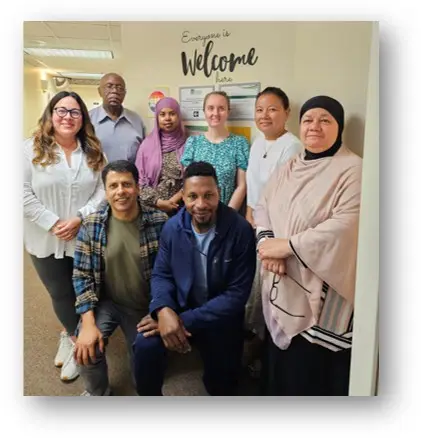
An interview with Ann Duckless, Community Educator
When a suicide or other traumatic loss occurs, postvention helps individuals, organizations, and communities navigate the aftermath and begin healing. While evidence-based strategies are at the core of postvention training, cultural relevance is essential to providing meaningful support. We sat down with Ann Duckless, who has facilitated more than 1,000 trainings across the globe, to talk about what she’s learned about tailoring training to different communities — whether that’s faith communities, Tribal Nations, refugee populations, schools, or other organizations.
You’ve said cultural relevance is about more than adapting content for different audiences. What does that actually look like in practice?
No two communities are exactly alike. What works in one setting may not resonate in another. Taking the time to tailor training to the unique needs and context of each audience is essential to making sure it’s meaningful, relevant, and respectful of their own experiences, traditions, and values. After facilitating more than 1,000 trainings, I’ve learned that cultural relevance can take a lot of different shapes — sometimes it’s about what you include, and sometimes it’s about what you deliberately leave out.
Can you give an example of when restraint mattered more than direct engagement with a topic?
I recently worked with a Jewish community on suicide postvention training in the aftermath of a religiously motivated terrorist attack at a preschool. Our training focused on suicide postvention, but the trauma of the attack — and its intentional nature — was still looming large, shaping how participants viewed and discussed the curriculum.
At the same time, as an outsider, it would have been inappropriate for me to assume a shared understanding of that experience. Statements like “I know how you feel,” even when well-intentioned, can shut down meaningful dialogue. Yet the attack felt like the elephant in the room. For the training to be effective, it needed to be acknowledged in some way.
Rather than bringing it up directly, I introduced a parallel example involving a death by suicide in a school where there was also intent to cause harm. Participants immediately connected with the story, and that was the prompt they needed to start talking about the attack their community had been through. That paved the way for us to talk about postvention in a way that made sense and could be deployed meaningfully.
Sometimes the most important role a trainer can play is creating space for communities to share their own experiences and guide conversations in ways that feel authentic to them.
You’ve also talked about the importance of listening and letting communities lead. What has that looked like when working with Tribal Nations?
When working with Tribal Nations, it’s essential to approach conversations with humility and respect for both cultural traditions and generational differences. Communities bring generations of wisdom and lived experience that no outside trainer can replicate.
In one recent training, in a community where there had been several deaths by suicide, we were grappling with strongly held generational differences of opinion about how to address the topic. Elders opposed saying the word “suicide”; they strongly believed it would bring negative energy into the community. Younger participants felt strongly that suicide needed to be named directly in order to prevent future tragedies.
My role wasn’t to determine which viewpoint was right. My role was to listen, understand, and support a conversation that honored the community’s values while advancing prevention and healing — and to allow room for both perspectives.
I’ve found a similar dynamic in many youth trainings. When we create a climate of respect and curiosity, participants are more open to learning and more receptive to the training’s messages.
What role does storytelling play in your trainings, particularly with refugee communities?
Some of the most powerful moments in training happen when people have the opportunity to share their stories. I’ve seen this repeatedly while working with refugee communities. Many participants carry experiences of trauma that began long before arriving in the United States and continued through their time in refugee camps and resettlement. Those experiences shape how loss, healing, and support are understood.
In these settings, effective training requires flexibility. Sometimes that means setting aside parts of the agenda to listen. Sometimes it means finding new ways to connect the material to participants’ lived experiences. When people can see themselves reflected in the conversation, the information becomes more than training content — it becomes something they can use, share, and apply within their own communities.
Looking back over these experiences, what’s the throughline for you?
Cultural relevance is a core component of effective support. When we listen first, honor community wisdom, and create space for authentic dialogue, postvention efforts become more meaningful, more trusted, and ultimately more effective.
The Connect Suicide Prevention Program offers comprehensive training for schools, colleges, organizations, and communities. Interested in bringing a ConnectTM training to your school or organization? Learn more at https://TheConnectProgram.org or contact us at info@TheConnectProgram.org.

